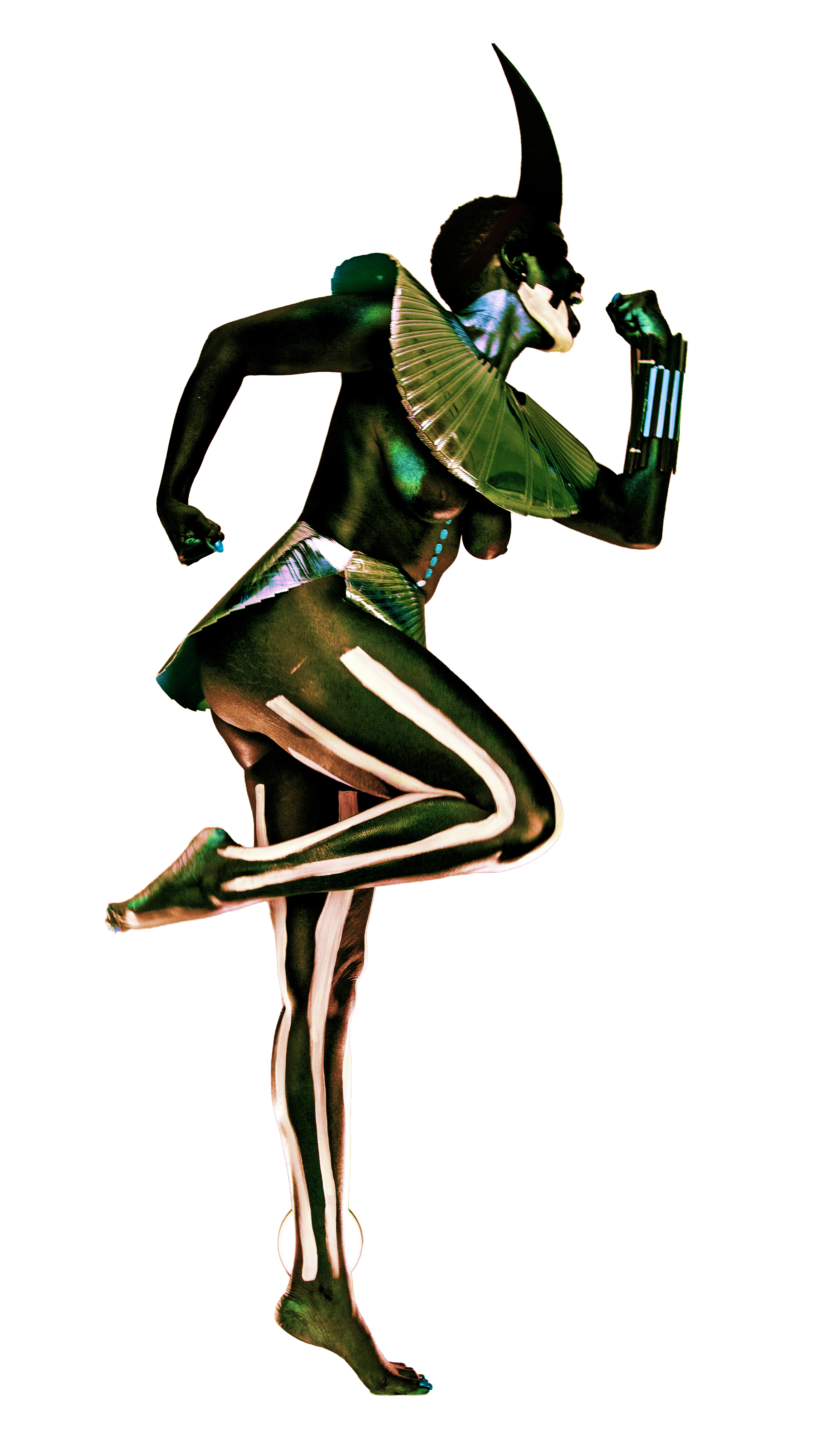
There is a question that lives at the center of NU AFRICANS, the new exhibition opening September 18 at Hammonds House Museum: if Africans of the Diaspora were forged in the crucible of bondage and oppression, have they not — through that very survival — evolved into their own tribe? Their own customs. Their own language. Their own mythology.
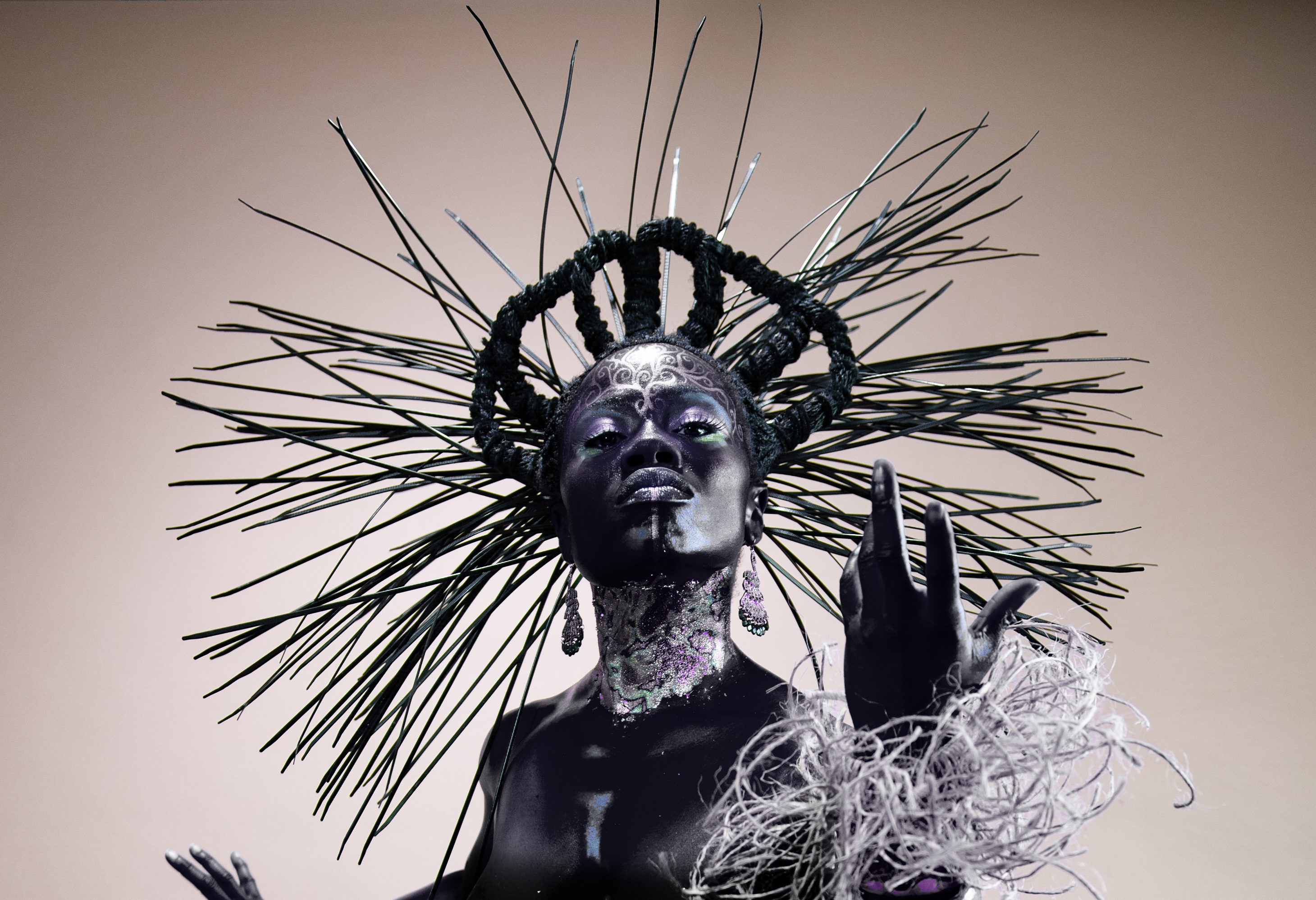
Maurice Evans, the Atlanta-based artist behind the series, calls them NU AFRICANS. And in the hands of Evans and his collaborator, the Kenyan American sculptor Grace Kisa, that idea becomes visual: a collection of mixed-media portraits in which Black women are costumed as warriors and queens, painted and photographed, then layered with acrylic, watercolor, silver leaf, and pyrography on wood panel until they belong to a world that is at once ancestral and not-yet-realized.
The exhibition takes its visual roots from Africa, but the women featured are from this time and place. Each was costumed by Kisa and photographed by Evans in two looks — as a warrior and as a queen — inspired by the legendary warrior queens of the African continent and the Americas. The intention is to subvert stereotypes, challenge eurocentric standards of beauty, and create space for agency, engaging the mechanism of Afrofuturism to imagine an alternative existence.
A Gallery of Warriors and Queens
The series, first exhibited online during COVID in 2020 and curated by Leatrice Ellzy, has now arrived in person at Hammonds House. The works range from intimate 10" × 14" panels to larger 26" × 36" compositions, each one a photo collage built on a wood panel and built up with paint, leaf, and fire.
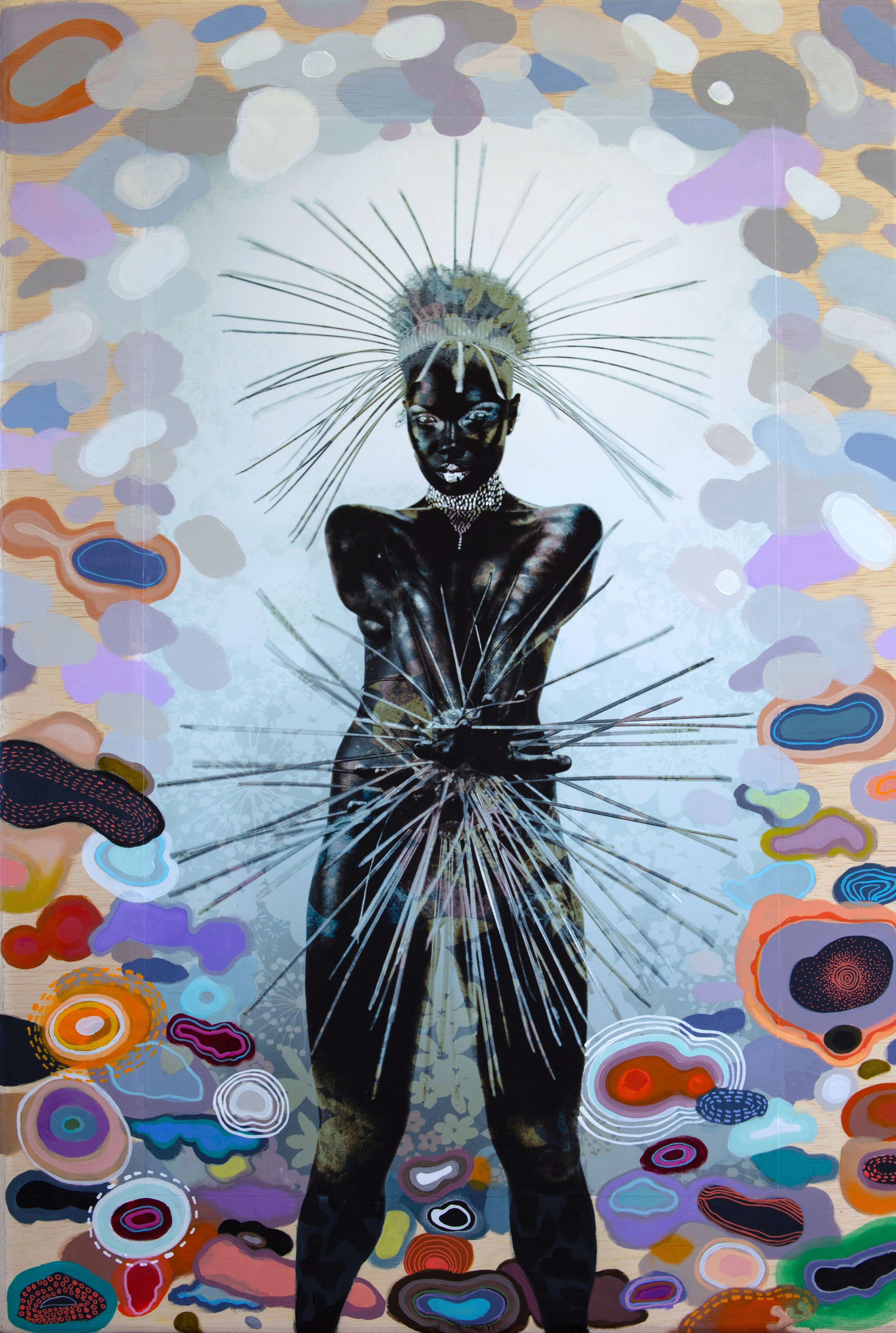
What makes these works singular is the process. Evans begins with a concept — often a model, body-painted — photographs it, then builds a painting around the photograph. The materials are wood panels, acrylics, oils, encaustics, pen and ink, paper cutouts, sometimes motorized parts. Kisa's sculptural sensibility enters through the costuming: the elaborate headpieces, the structural garments, the adornments that transform each subject from a person into an archetype.
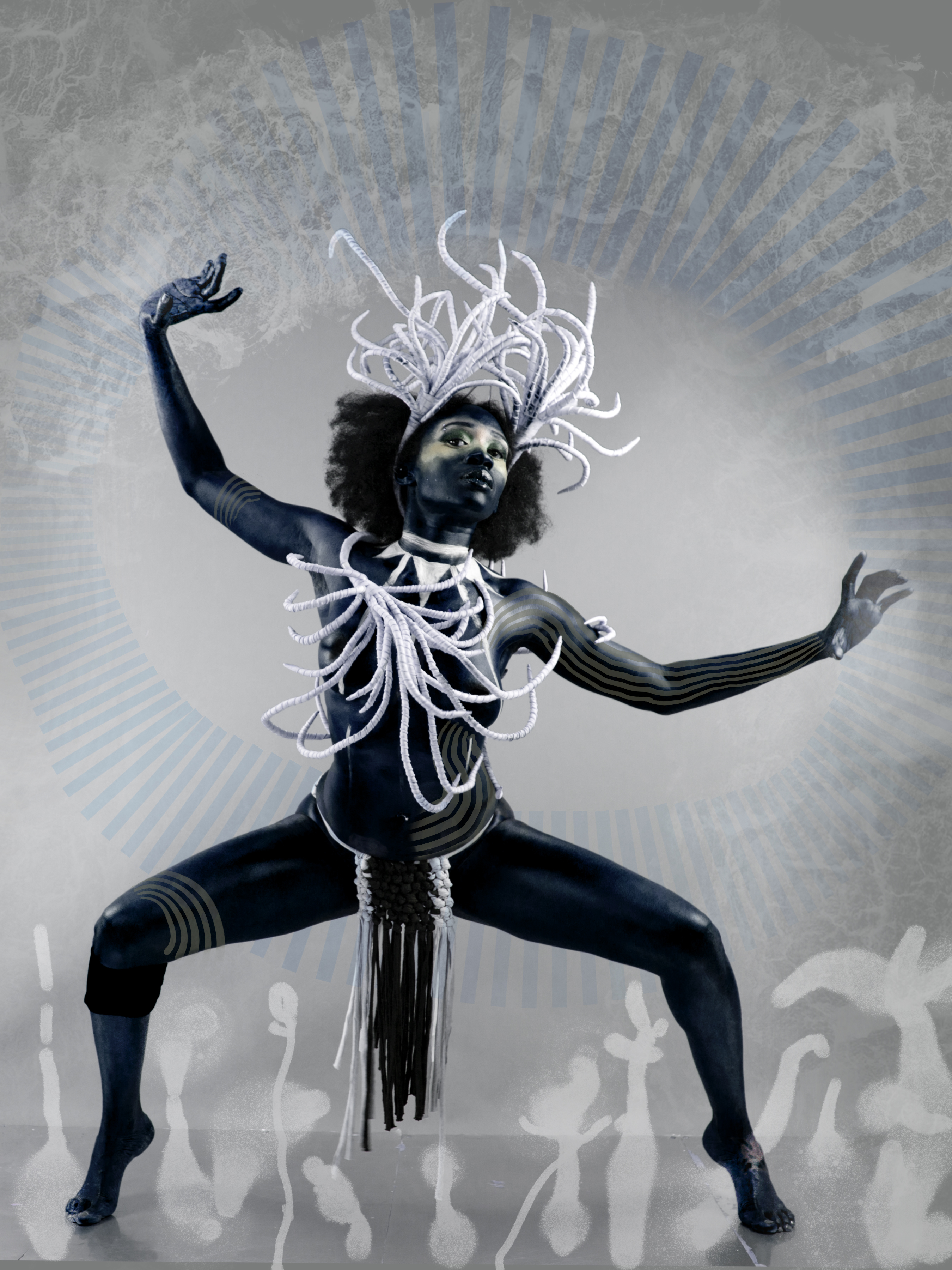
Black women on this side of the Atlantic have been working toward dismantling the systems of oppression that have impeded their liberation for centuries. The creative process for this series led the artists to research past and present warrior queens on both sides of the Atlantic — a celebration of fortitude that expands on ideas of memory, kinship, identity, and power.
Maurice Evans: From Smyrna to the World
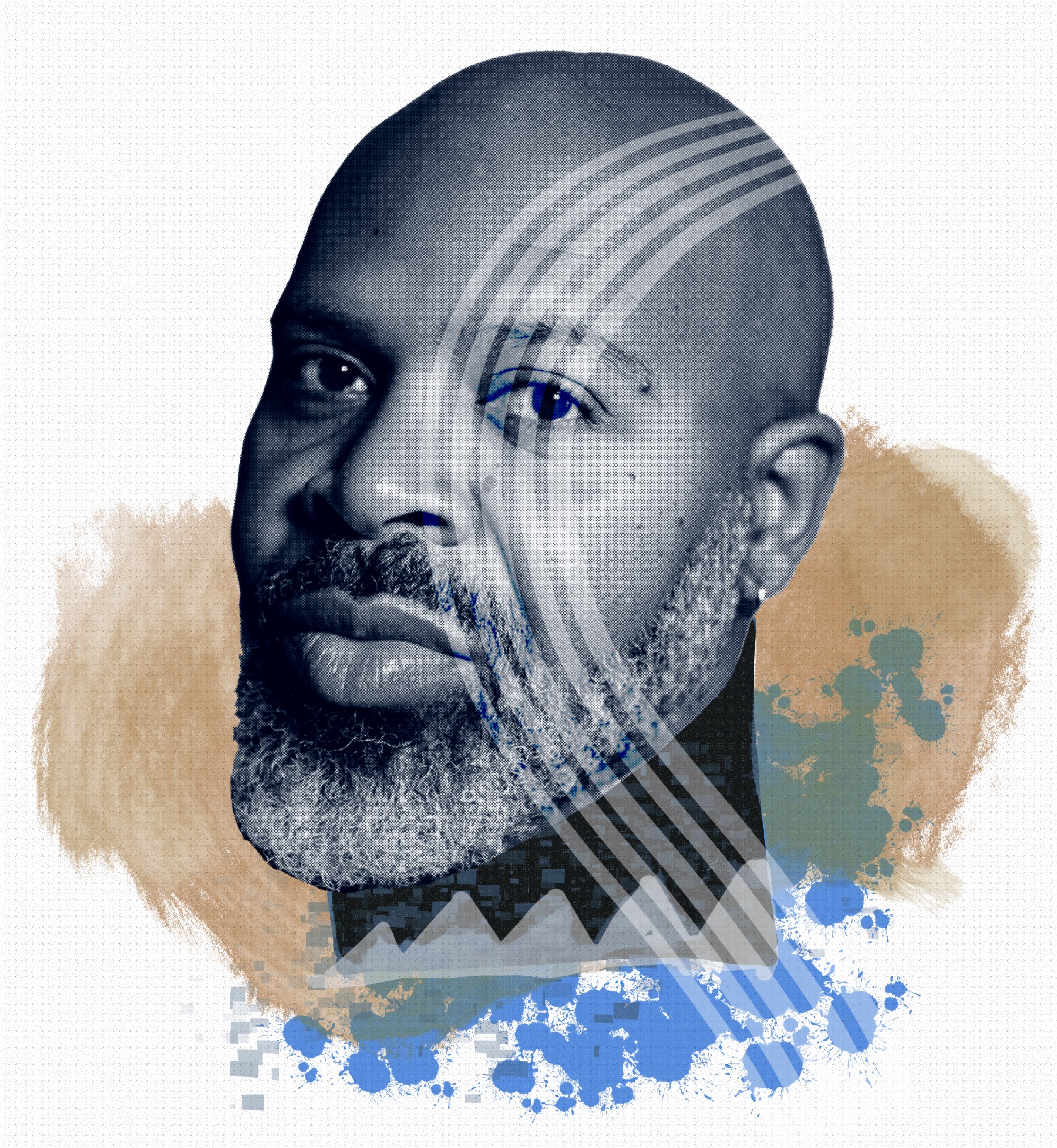
Maurice Evans was born in Smyrna, Tennessee but raised in Atlanta, Georgia. His creative focus was first realized through his relationship with music. His mother, a teacher, supported and reinforced his creative ability by allowing him to help design her classroom bulletin boards each year. By the time he graduated from Griffin High School, he had gained recognition as a talented artist and had the confidence to pursue his passion.
In 1986, he was accepted to the Art Institute of Atlanta, where he studied Fashion Illustration to advance his painting and drawing skills. After college, he pursued work at design firms but ultimately could not achieve the artistic freedom he yearned for as an independent artist. In 1994, with the support of family and friends, he had his first successful exhibition at the juried Black Arts Festival in Atlanta. From there, he bought a booth at the New York Art Expo, where he was introduced to new clients and collectors and grew to mass-produce his artwork for museums and galleries internationally.
Grace Kisa: A Life Between Places
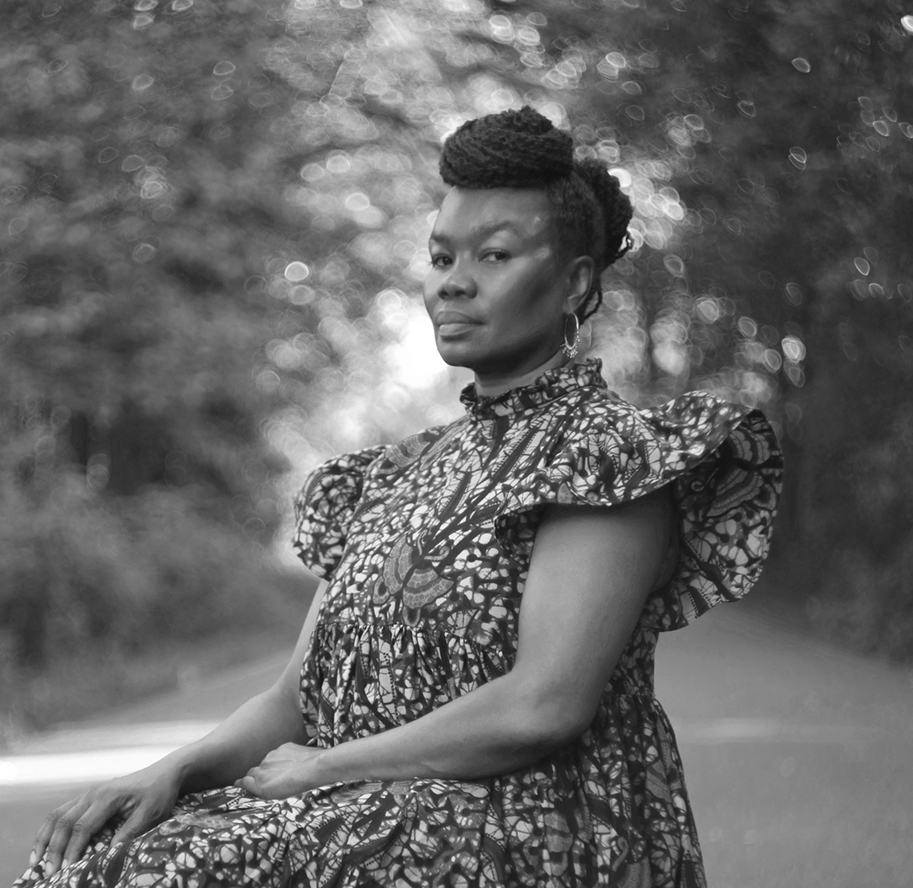
Grace Kisa is a Kenyan American artist based in Atlanta, Georgia. A multimedia artist whose primary expression is sculpture, her process is improvisational — a combination of creative play and problem solving. The materials she uses vary from clay, metal, wood, fiber, and resin, with a focus on recycling and repurposing ordinary objects. Her work draws inspiration from the experiences of a childhood spent in Kenya, Ethiopia, Botswana, Virginia, and as a practicing artist in Georgia.
By taking what is familiar and transforming it, she creates narratives that engage various histories while working through concepts of intersectional identities, examining the processes of migration and cultural exchange beyond borders. She graduated from the Art Institute in Atlanta and has worked as a professional artist for over 20 years, exhibiting in solo and group exhibitions across the United States. Her work has been published in The New York Times, Forbes, The Atlanta Journal-Constitution, ArtsATL, Black Art in America, and Rolling Out.
In 2024, Grace exhibited with the European Cultural Centre in Venice, Italy in the exhibit Personal Structures: Beyond Boundaries in the context of the Venice Biennale. In 2021, the Atlanta Beltline purchased artwork by collaboration artists Grace Kisa and Ellex Swavoni for their permanent collection.
Artist Statement — Grace Kisa
My work grows out of a life lived between places. Born in Kenya and shaped by movement across continents, I inhabit a space in-between. Where identity is fluid, hybrid and continually reconstructed. My practice maps this shifting terrain through sculpture, installation, and mixed-media assemblage. I explore migration, belonging, and the ways personal and ancestral histories travel with us across borders and generations.
I work intuitively with found and repurposed materials. Resin, clay, wood, metal, fiber, and everyday objects touched by human hands. These materials carry traces of movement and use. By binding, weaving and reconfiguring them, I affirm the possibility of renewal in what is discarded. This transformation mirrors the construction of identity itself. Layered, improvisational, and shaped by a lifetime of crossings.
African astronomy and cosmology are essential sources of inspiration in my work. I look to the ancient observatories like Noramatunga, star-mapping traditions, and mythic narratives that oriented communities long before modern navigation. The sky becomes a metaphor for continuity, an enduring archive of ancestral knowledge that connects past and present. In my sculptures, celestial symbolism anchors diasporic experience, grounding contemporary identity in the long arc of African scientific and spiritual understanding.
Equally important are the digital networks that shape our modern lives. Just as stars form constellations through imagined lines of connection, digital systems weave invisible threads across continents, linking diaspora communities in real time. I see networks as a contemporary counterpart to ancient sky-mapping. Both are systems of orientation, relationship and memory.
Across my practice, I look for points of connection between continents and cosmologies, between ancestral knowledge and digital futures, between what we inherit and what we imagine. My sculptures become portals where histories converge, where migration becomes a source of strength, and where fragmented experience is reassembled into something whole.
The Curatorial Vision
Curator Christopher Swain frames the exhibition not as a geographic or cultural designation, but as a state of becoming — an identity shaped by ancestral memory while remaining responsive to migration, displacement, technology, cultural exchange, and the realities of modern life.
NU AFRICANS recognize the complexity of the contemporary Black experience while celebrating the creativity that emerges from it. The exhibition ultimately asks viewers to see Africanness not as something confined to history or geography, but as a living continuum — one capable of adapting without losing its connection to its origins.
Visit
NU AFRICANS opens with a first look on Friday, September 18, 2026, from 6:30–9 PM. The exhibition runs through December 13, 2026. Reserve your tickets for opening night →
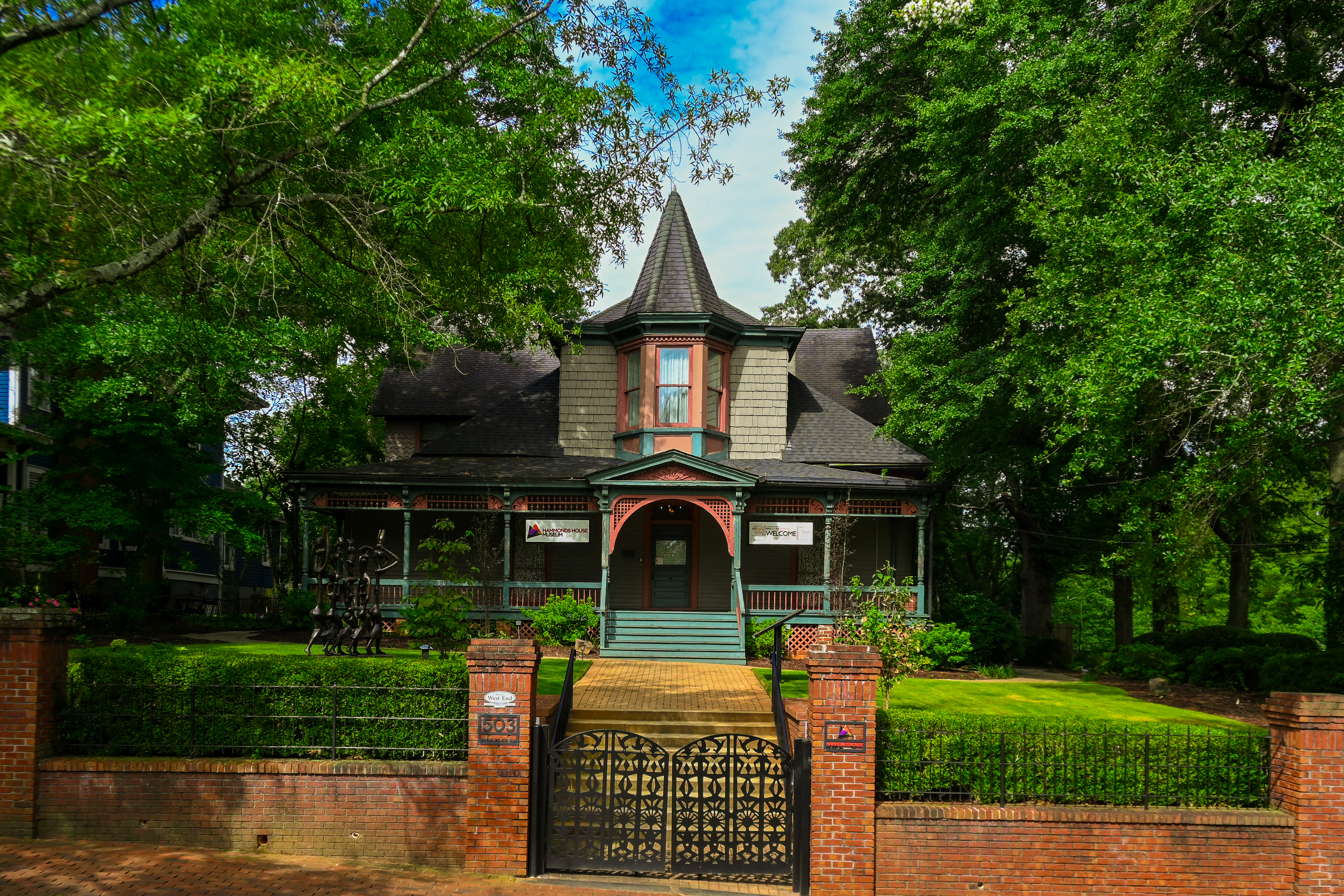
Hammonds House Museum is located at 503 Peeples Street SW, Atlanta, GA 30310, in a beautiful Victorian home with a John Rhoden Sculpture Garden on the grounds. The museum is a 501(c)(3) arts organization whose mission is to celebrate and share the cultural diversity and legacy of artists of African descent. The home is the former residence of the late Dr. Otis Thrash Hammonds, a prominent Atlanta physician and passionate arts patron.
The museum's 2026 exhibitions include artist talks and civic engagement activities that serve as opportunities for the community to have a deeper experience with the artworks. For information about upcoming events, to join the mailing list, become a member, or plan your visit, go to hammondshousemuseum.org.
Hammonds House Museum is generously supported by Fulton County Board of Commissioners through the Fulton County Department of Arts and Culture, the City of Atlanta Mayor's Office of Cultural Affairs, Community Foundation of Greater Atlanta, National Performance Network, Georgia Council for the Arts, The Estate of Dr. Doris Derby, and their newest sponsor The Ruth Foundation for the Arts (Ruth Arts), as well as donors and members.


Artist Statement — Maurice Evans
Because I'm an artist in many different mediums, I try to incorporate as much of my talents as possible. Many of my works contain photography, painting, and construction. With mixed media work, I often start off with sketches of a concept that I try to translate into photographs. Most of the time the concept revolves around models that I body paint. Once I capture the images that I'm happy with, I then come up with a concept for a painting inclusive of the photographs. At this point in the creative process, it is important to stay open to the possibilities. This is where, as an artist, you must get out of your own way. Let the images and your imagination dictate what is going to happen next. The materials I often use (but not limited to) are wood panels, acrylics, oils, encaustics, pen and ink, paper cut outs, sometimes motorized parts, and models.